
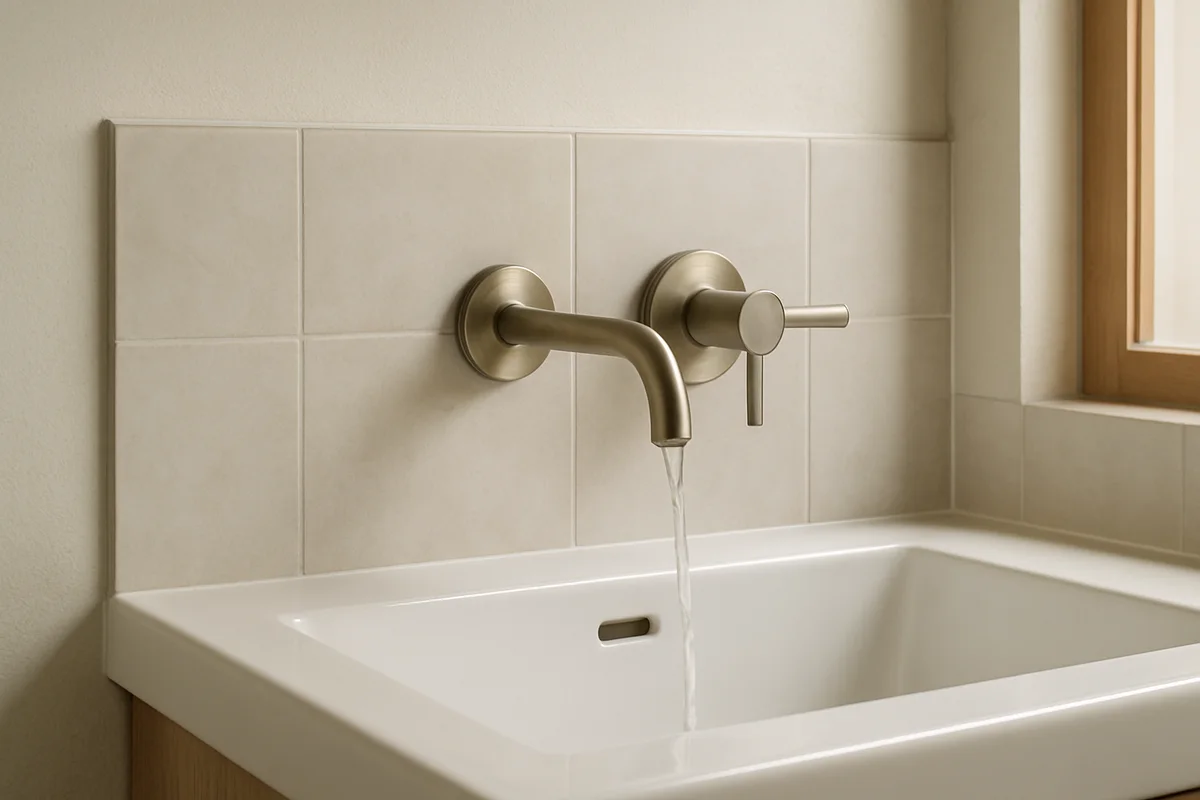
A faucet or shower trim kit is a visible finish, but its rough-in parts live behind the wall or under the counter. Choosing the model only after the wall is closed can mean extra work or a fixture that does not fit the installed valve.
Confirm what belongs together
For a shower, ask whether the trim kit includes the valve or requires a specific valve body. Different brands and product lines are not always interchangeable. Check the installation sheet for rough-in depth, handle clearance, and required access. A tub spout may have a specific connection type and distance from the finished wall.
For a sink faucet, confirm the number and spacing of deck holes, the sink or counter thickness, and the clearance to a backsplash or window. A tall faucet can be useful with a deep basin, but the spout reach and splash pattern matter too. If choosing a wall-mounted faucet, its height and reach need to be coordinated with the sink before the wall is finished.
Keep a record at the job
Give the contractor the exact manufacturer and model number, not just a picture or finish name. Include the product sheet and note what has been ordered. Verify that the parts have arrived and are complete before the installation stage that hides the connections.
There is a tradeoff between a special fixture and a readily available one. A distinctive finish may take longer to arrive or be harder to replace. Ask about lead time and replacement parts, then weigh that against the look you want. The right time to resolve compatibility is before the pipe ends are set, not when the handle is in your hand.